> For the complete documentation index, see [llms.txt](https://docs.hunt.town/llms.txt). Markdown versions of documentation pages are available by appending `.md` to page URLs; this page is available as [Markdown](https://docs.hunt.town/hunt-town/factory-model.md).
# The Factory Model
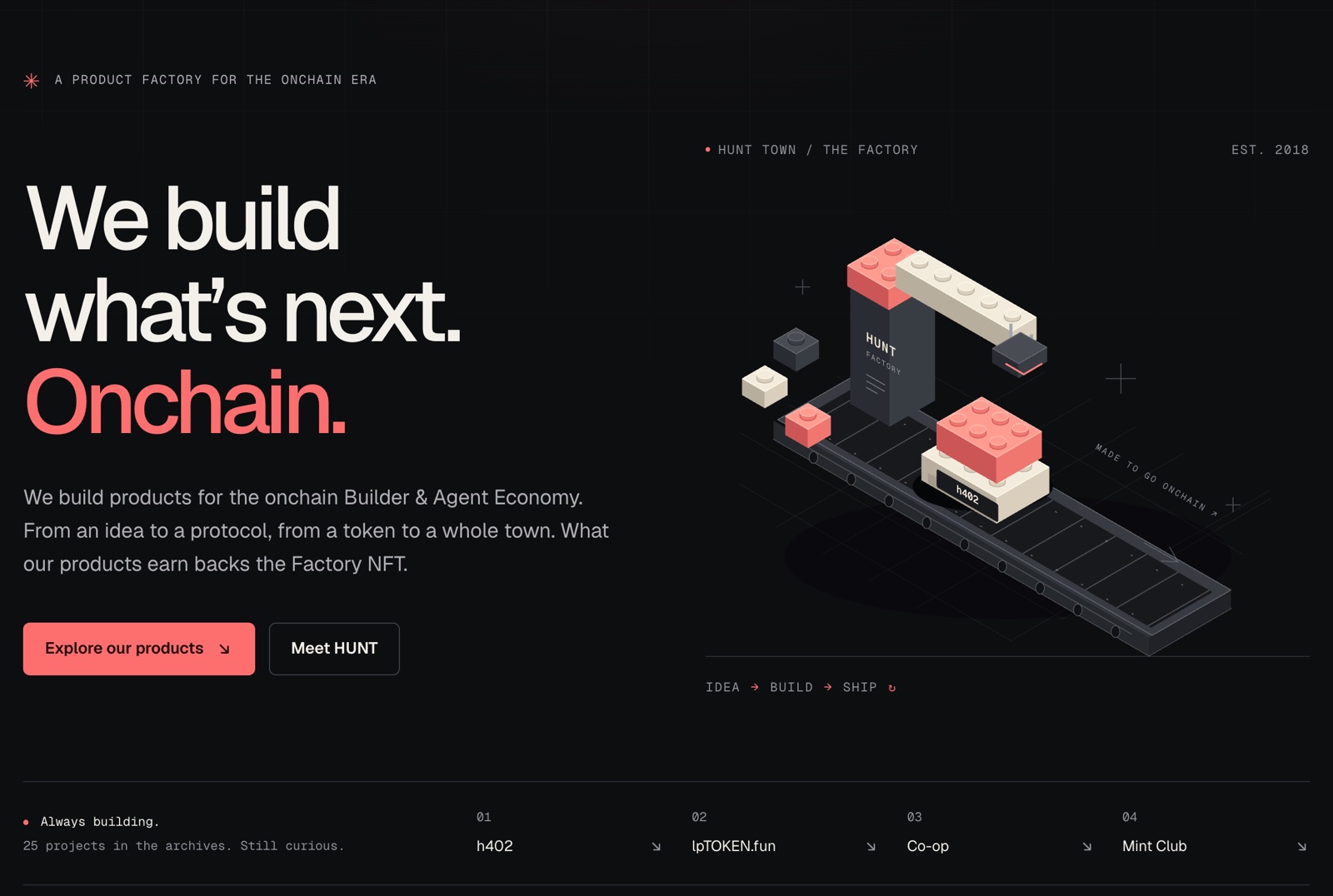
Hunt Town is an **Onchain Product Factory**. We design, build, ship, and operate many products over time rather than maintaining a single app forever.
What makes a factory coherent is that its products are not isolated. Ours share an economy, a set of primitives, and a community, and they feed one another. Product revenue also backs one shared asset: the [Factory NFT](/factory-nft/overview.md).
hunt.town
## Build → ship → seed
Every product follows the same arc, and the last step is the one that makes the factory compound:
1. **Build:** take an onchain primitive (curation rewards, bonding curves, NFT ownership, liquidity positions, agent payments) and turn it into a product real people can use.
2. **Ship:** launch it, grow it, and operate it for as long as it serves the ecosystem.
3. **Seed:** when a product is retired or evolves, its mechanics, its community, and its lessons **seed the next product**.
The [Archives](/track-record/build-log.md) show what each product seeded. Steemhunt's reward-curation model seeded everything. Neverlose.money's lock-up mechanics fed Mint Club's tooling. Hunt Tip's NFT-allowance tipping seeded the Co-op.
## Products → HUNT → the Factory NFT
Product revenue buys HUNT, and that HUNT goes into the Factory NFT, where it raises the NAV per NFT for every holder at once. There is no deposit schedule and no set amount. See [The NAV Vault](/factory-nft/nav-vault.md).
## The shared foundation
Active products are not built from scratch each time. They draw on a shared foundation:
* [**The Factory NFT**](/factory-nft/overview.md): the one asset that product revenue backs.
* [**HUNT**](/hunt/hunt-erc20.md): the token that revenue buys for the Factory NFT, and the reserve behind Co-op project tokens.
* [**Mint Club**](/mint-club/overview.md): the bonding-curve protocol that Co-op and other HUNT-backed tokens are issued on.
A new product uses the parts that fit instead of reinventing them.
## Active products and the archive
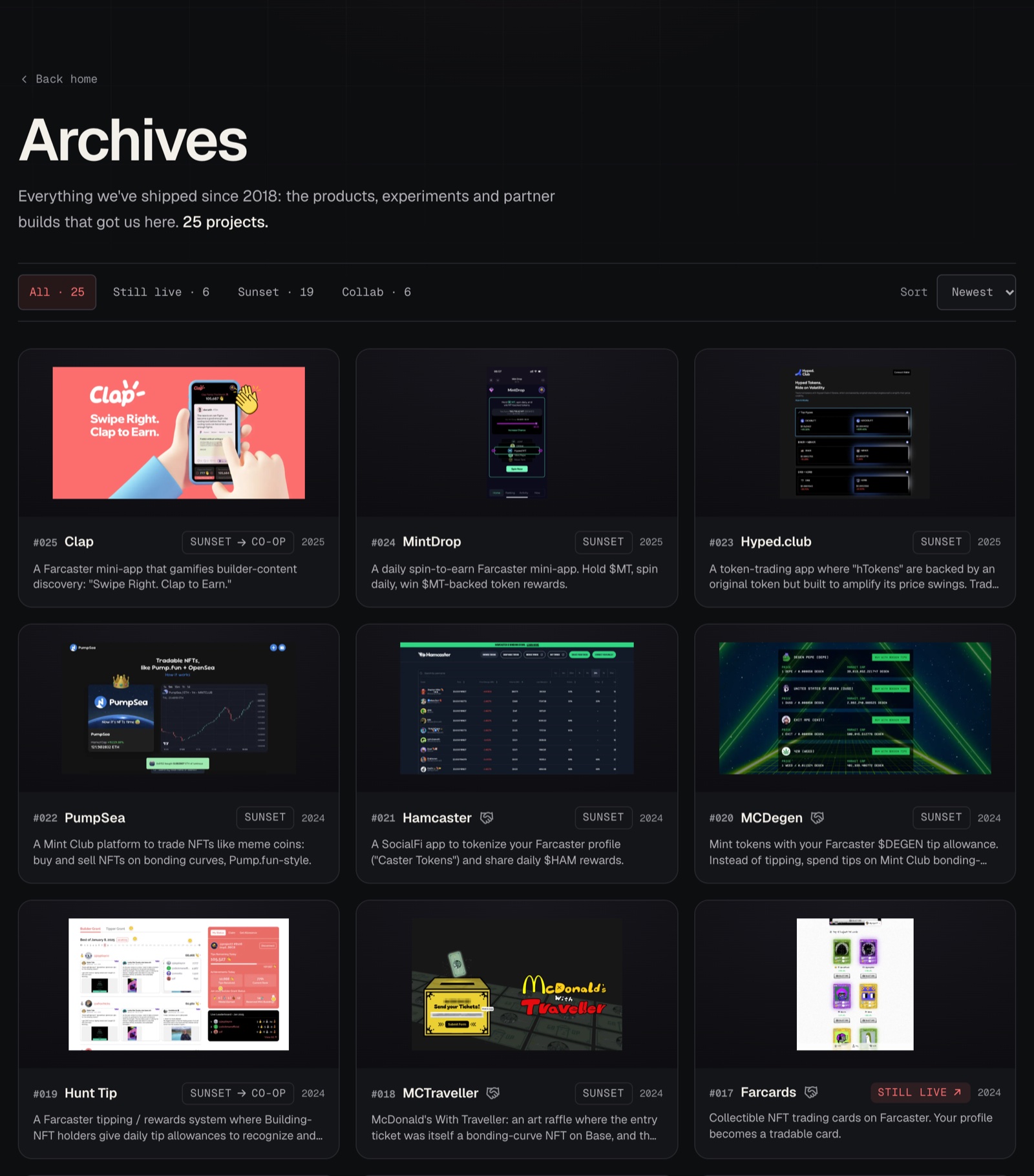
At any time the factory runs a small set of **active products** and keeps a much larger record of **previous products** in the [Archives](/track-record/build-log.md). The retired products are the track record that earned the factory its current thesis.
We archive fast. A product that does not work out, or that leaves the main focus and runs in maintenance mode, is archived quickly so the team's resources go to new products.
The Archives on hunt.town
## Builders and holders
**Builders** launch tokens and projects on the factory's primitives. **Holders** buy, trade and hold what builders launch, and can hold the Factory NFT itself. A third participant now joins them: **software agents** that transact on their own behalf. See [The Builder & Agent Economy](/hunt-town/builder-agent-economy.md).